
Pay-per-click advertising was much simpler back then. You would choose twenty specific keywords for it and then you would pair these keywords with one ad headline that never changed. After that you would route them to a dedicated landing page, and call it a day. If you try running that exact playbook today, your budget will burn faster than a dry leaf in July, and your conversion reporting will look like a ghost town.
Something big has changed under our feet. Tools that create content, search engines that talk back and smart AI summaries have completely changed the way people find answers online. People aren’t typing short phrases like “best shoes” anymore. They’re typing (. Saying) complicated very specific questions like: “What are the most durable lightweight trail running shoes for wide feet under $150 with good arch support?”
By the time a user clicks your paid ad today they aren’t just beginning their research- they’re to making a decision. They come with information, high hopes and no time for ads that don’t make sense or experiences that don’t work well. So, how do you adapt your paid media architecture to win over these hyper-informed buyers?
It starts by ditching rigid, micro-segmented keyword structures and rebuilding your account around three core principles: intelligent consolidation, rich conversion signals, and flexible asset variation.
The New Search : Why Buyers Arrive Pre-Qualified
To understand why campaign structures must evolve, we have to look at how user behavior has transformed.
Historically, the consumer search journey was fragmented. A user would perform a broad query, scan a list of ten blue links, click around three different websites, take notes, go back to Google, search again with a slightly more specific term, and eventually make a purchase decision. Advertisers built granular Single Keyword Ad Groups (SKAGs) and intricate multi-step funnels specifically to guide users through that slow, manual discovery phase.
Now artificial intelligence models do the work of putting things together before the person even arrives at your website. AI search summaries read reviews, look at features put together- the good and the bad and answer multi-part questions right on the search results page.
| Search Journey | Process |
| Old Way | Broad Search → Scan Links → Compare → Refine → Buy |
| AI Era | Complex Contextual Query → AI Synthesis → Direct Click |
When a potential customer finally decides to click an ad, they are already informed. They do not require a beginning-level explanation; they want a easy answer to their specific business problem or personal need. If your ad account is still split into small campaigns with strict keyword match types and unchanging ad copy, you end up limiting the platform’s machine-learning algorithm from getting the information it needs to find and reach these moments of high interest.
Legacy vs. AI-Era PPC Account Structure
Let’s see how modern campaign management differs from traditional setups:
| Campaign Dimension | Legacy PPC Structure (Pre-AI Era) | Modern AI-Era PPC Structure |
| Account Granularity | Micro-segmented SKAGs, dozens of niche campaigns | Consolidated campaign themes centered on core business goals |
| Targeting Focus | Strict keyword match types and exact query containment | Intent-driven signals, audience themes, and broad query matching |
| Bidding Strategy | Manual CPC or basic target CPA focused on raw lead volume | Value-Based Bidding (tROAS / Max Value) feeding offline conversions |
| Ad Creative | Static, rigid text headlines tied to specific keywords | Flexible, dynamic assets dynamically assembled by machine learning |
| Data Optimization | Signals split across thin, low-volume campaign silos | High conversion density pooled into unified learning algorithms |
| User Intent Handling | Assumes cold, uninformed searchers doing initial research | Accommodates warm, pre-informed searchers seeking immediate value |
Strategy #1: Connect with Humans Through Intelligent Consolidation
There is a common misconception that AI-driven PPC means throwing all your budget into one giant campaign and hoping for the best. That isn’t strategy—that’s gambling.
The real goal of modern campaign architecture is finding the sweet spot between strategic separation and data consolidation.
Why Excess Segmentation Harms Performance
When you divide your ad spend into twenty micro-campaigns, you divide your conversion data into twenty tiny puddles. Google’s Smart Bidding and automated targeting algorithms thrive on deep, continuous streams of data. An algorithm needs roughly 30 or more conversions per campaign within a 30-day window just to establish baseline statistical patterns.
If your niche campaigns only get 3 to 5 conversions a month, the system operates blind. It cannot effectively predict which auctions are worth aggressive bids and which ones are a waste of money.
By consolidating similar product lines or service offerings into unified campaign structures, you pool your conversion data. This gives the AI information to spot small signs of buying behavior during complicated paths that involve many different steps.
When Strategic Separation Is Still Necessary
Consolidation should never mean giving up business control. You should still segment campaigns whenever a real-world business constraint demands it:
- Dedicated Budget Protections: If a flagship product or high-margin service requires a guaranteed portion of ad spend, it needs its own campaign wrapper. Otherwise, high-volume, low-margin products might consume the entire budget.
- Different Performance Targets: A big ticket B2B service that costs five hundred dollars to get one customer should not be in the group as a simple software download that only costs twenty five dollars to get one customer. When you mix these two different financial goals it gets confusing for the algorithm that decides how much to bid.
- Compliance and Brand Guidelines: Some industries like finance and healthcare have strict rules that they have to follow. For example, these companies need to include warnings and disclaimers when they say something. They also have to follow certain criteria about what these finance and healthcare companies can convey and these rules must be applied to each group of ads. Before you make a new group of ads ask yourself: Does this group help my business or am I just making it harder for the algorithm to understand what is going on?
Strategy #2: Power Your Campaigns with High-Quality Conversion Data
In today’s world the machine learning decides how much to bid on ads. So your advantage is not how well you manage your keywords. Your advantage is how good the data is that you give to the advertising network.
If you give the computer low quality data it will try to get bad results.
The Danger of Treating All Conversions Equally
A B2B software company intends to run ads to get people to sign up. If the ad is set to optimize for people who sign up the AI engine will try to get the cheapest clicks that result in a sign up or form submission.
On paper it looks like the person managing the ads is doing a job because the cost per customer went down by forty percent.. Really eighty percent of the people who signed up are not good leads. They are people who signed up for no reason or spam bots. The ad optimized for quantity over quality because the platform was not told which leads were good.
To fix this you need to use something called Value Based Bidding and Offline Conversion Tracking.
You need to give values to different actions that people take. For example, a whitepaper download might be worth five dollars. A demo request might be worth fifty dollars and a closed sale might be worth one thousand dollars.
You have to connect your CRM to your advertising account. When a sales person says a lead is good or closed, youe need to send that information to Google Ads.
Then switch to a bid strategy that focuses on value & once you start getting data, switch from “Maximize Conversions” to “Maximize Conversion Value” or “Target ROAS (Return on Ad Spend).”
When you do this the platform’s AI will stop trying to get clicks and will try to get good leads that match your ideal customer.
Strategy #3: Build Ads That Can Be Used On Every Surface
The third critical pillar of modern PPC architecture is how you construct and deliver creative assets.
AI search interfaces pull content dynamically across search feeds, video modules, discovery panels, and contextual sidebars. Static ads just don’t work in that environment anymore.
Your creative needs to be modular, hyper-relevant, and ready to convert buyers who already know what they’re looking for – regardless of where or how your ad pops up.
Audit Your Creative Assets Against the Informed Buyer’s Mindset
When crafting headlines, descriptions, callouts, and image assets for responsive ad formats, evaluate every component through the eyes of a customer who has already researched your industry:
- Does it immediately state what you do? Avoid vague fluff like “Innovative Solutions for Tomorrow.” Use clear, explicit messaging: “Enterprise Cloud Security Software.”
- Does it pre-qualify the audience using price or scope? Including pricing parameters (“Plans starting at $499/mo” or “For teams of 50+”) filters out unqualified clicks before they cost you money.
- Does it leverage instant trust signals? Incorporate real-world proof points directly into ad extensions and asset headlines such as “G2 Rated #1 Platform,” “Over 10,000 Active Users,” or “SOC-2 Type II Certified.”
- Does your landing page really give people what your ad said it would? If your ad talks about something like a certain feature or something people can use it for then the page they go to needs to say the same thing right away. People do not want to search over the page to find what made them click on the ad in the first place.
When you give the ad platform a mix of pictures and words it can make the perfect ad for each person at that moment. It looks at what the person’s doing what device they are using and what they are looking for and it makes an ad that is just right for them.
Visualizing Modern Paid Search Architecture
| What Goes Into the Ad | What It Does |
| Value Proposition Headlines | Communicate the main benefit or reason to choose the product/service |
| Social Proof Signals | Build trust using reviews, ratings, testimonials, or credibility signals |
| Dynamic Price Points | Show pricing that can be adapted to the user or advertising context |
| Direct Problem-Solving Descriptions | Explain how the product/service solves the customer’s specific problem |
| High-Impact Visual Assets | Use compelling images or visuals to capture attention |
| Contextual Call-to-Action Buttons | Encourage the user to take the most relevant next step |
| AI Assembly | AI combines the most suitable assets for each user and auction |
To visually conceptualize how campaigns are organized in today’s performance environment, here is a breakdown of a modern, data-dense account hierarchy:
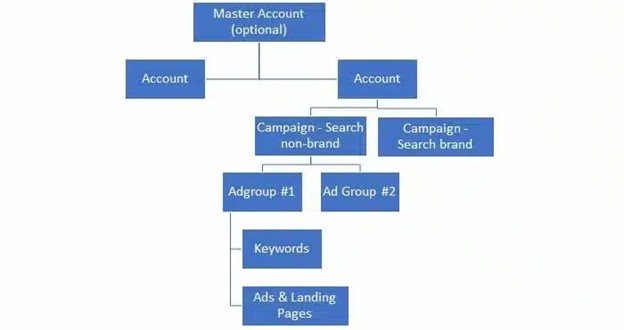
Standard account hierarchy optimized for clear reporting and campaign control. Source: Search Engine Land
In this structured environment, high-level business goals dictate campaign separation, while ad groups house tightly themed creative assets supported by shared audience and conversion signals.
How Wibits Digital Transforms Your PPC Strategy for the AI Era
Navigating the rapid evolution of paid search isn’t easy. If you’re trying to adapt legacy accounts to modern search trends while running day-to-day business operations, it’s easy to waste ad spend on outdated campaign frameworks.
That’s where Wibits Digital comes in.
As a PPC agency in Nagercoil, we help local businesses deal with complex AI ad systems to drive real, measurable revenue. We undertake top-to-bottom campaign overhaul, better conversion tracking, full multi-channel paid strategy and build data-led campaigns that actually convert.
We don’t just set up ads and walk away. We constantly refine and rebuild accounts around how people actually search and buy today, putting your brand right in front of ready-to-buy customers at the exact moment they’re looking for what you offer.
Our Core Paid Media Services:
- Google & Bing Ads Overhauls: We go through Google and Bing Ads accounts that’re a mess and outdated. We clean them up. Make sure the keyword lists are not too big. We want Google and Bing Ads to work well with the bidding systems that use artificial intelligence. So we make campaigns that are easy to understand and work well.
- Conversion Tracking & Signal Setup: We configure offline conversion tracking, dynamic value pass-backs, and enhanced conversion data so the ad platforms learn who your actual high-value buyers are.
- Flexible Creative & Asset Development: Designing modular ad copy, compelling visual creative, and high-converting landing page experiences tailored to informed buyers.
- Scalable White Label Solutions: Partnering with agencies worldwide as a top PPC agency to deliver end-to-end client success. From stealth campaign audits to full account management, our agency handles the heavy lifting under your brand name.
If you are an agency looking to expand your client offerings without increasing internal headcount, Wibits Digital provides world-class white label PPC services. We act as your invisible engine, handling campaign architecture, creative optimization, and transparent reporting.
Brands and agencies looking for a leading agency for white label Google ads rely on our certified ad specialists to maximize campaign efficiency. Whether you require complete white label Google ads management or dedicated campaign audits, Wibits Digital delivers measurable ROI.
FAQs
1. Does AI search mean keywords are completely dead in PPC?
No keywords are not dead. The way they are used has changed. No more depending on strict and exact match keyword groups. Current campaigns use wide intent signals and topics. Keywords now help the algorithm understand what people want instead of rigid filters.
2. How many conversions does a campaign need for AI bidding to work properly?
A campaign usually needs 30 real conversions in a 30-day time frame. This starting point gives Smart Bidding system’s information to understand, improve and correctly guess how likely a conversion will happen.
3. What is Value-Based Bidding, and why is it important now?
It tells the platform what specific conversions are actually worth to your business than treating every lead or sale as equal. This guides AI algorithms to prioritize high-intent prospects over cheap low-quality clicks.
4. How can Wibits Digital help if my current PPC campaigns are stagnating?
We start with a look at your account to find out where things are going wrong. This could be because of an account setup or poor tracking. It could also be because the pictures and words we use in our ads are not interesting anymore. From there, we rebuild your paid media strategy to align with modern search algorithms & redirect your ad spend toward high-intent buyers who are ready to convert.
Partnering with Wibits Digital gives you a future-proof PPC strategy built for actual business growth.