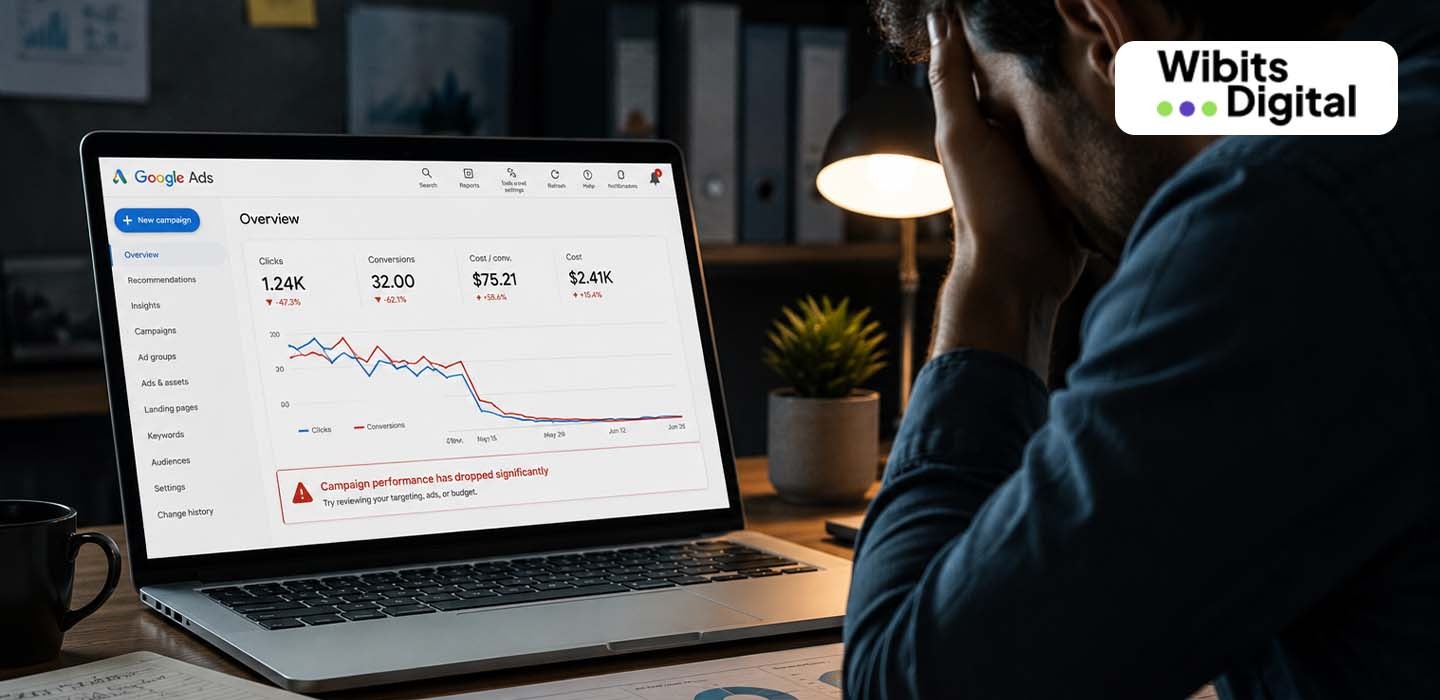
It’s not unusual for a Google Ads campaign to perform well for months and then quietly lose momentum. Nothing obvious has changed, yet the results no longer look the same.
“We haven’t changed anything.”
The campaign has been running for months. Enquiries have been steady. Cost per lead has been predictable. Then, almost without warning, the numbers start drifting in the wrong direction.
Clicks are still coming in, but enquiries slow down.
Or impressions fall even though the budget hasn’t changed.
Sometimes everything looks normal inside Google Ads until someone checks the sales figures.
It’s tempting to assume something has broken.
Quite often, nothing has.
Google itself points out that fluctuations in Search campaign performance are normal and can happen for many reasons, including changes in competition, budgets, bidding strategies, targeting, conversion tracking and overall auction dynamics.
A Campaign Doesn’t Compete Against Yesterday
One thing that’s easy to forget is that Google Ads isn’t a fixed system.
Every search is an auction.
That auction changes all the time.
A competitor increases their budget.
Another business starts bidding on the same keywords.
Search behaviour shifts.
Google introduces new features.
The campaign you’re looking at today isn’t competing against the same environment it was competing against three months ago.
That’s why an account can slowly lose performance even when nobody inside the business has touched a single setting.
Success Can Quietly Create New Problems
A campaign performs well. The business gets busy. Attention moves elsewhere. Weeks become months. Nobody looks too closely because the account has been “working.”
That’s surprisingly common.
The campaigns that perform well for a long time are often the ones reviewed the least.
Search terms change.
New competitors enter the market.
People begin asking different questions on Google.
The campaign keeps showing ads, but the market around it keeps moving.
Google’s own guidance lists changing auction dynamics and shifts in search demand among the most common reasons campaign performance changes over time.
More Clicks Doesn’t Always Mean Better Traffic
One report might show clicks increasing. Another shows enquiries falling. It sounds odd, but it happens more often than people think.
They often do.
Imagine someone searching for a product two years ago. The way they searched then isn’t necessarily how they search today.
Queries have become longer.
People compare more options.
Many spend longer researching before they ever contact a business.
That means campaigns sometimes begin attracting a different mix of visitors without the advertiser noticing immediately.
The account hasn’t necessarily become worse. The people arriving on the website may simply have different intentions than they did before.
Small Changes Can Echo for Weeks
Businesses often expect performance changes to happen overnight.
In reality, some of the biggest shifts begin with very small adjustments.
A landing page is redesigned.
A conversion action is changed.
Someone switches bidding strategies.
A budget is tightened.
None of those decisions automatically hurt performance.
Some changes take time before they show up in the numbers.
New bidding strategies, modifications in conversion tracking or the optimization of campaign settings may have an effect on the performance in the upcoming days while Google’s system is collecting new information.
This explains why seasoned PPC specialists generally refrain from making drastic decisions just a day or two after new changes have been implemented.
Good Campaigns Don’t Look After Themselves
One of the biggest misunderstandings about Google ads management is that a campaign can eventually be left alone because it’s already performing well.
In reality, that’s often when regular reviews become even more important.
Search terms change.
Competitors come and go.
Customer behaviour shifts.
None of those things send a warning before they happen.
Campaigns that keep delivering results usually have someone checking what’s changed, testing new ideas and making small improvements along the way.
Negative keywords get reviewed.
Search terms get cleaned up.
Ad copy gets refreshed.
Landing pages improve.
Competitor activity gets monitored.
For businesses working with a professional PPC management team, these reviews are often happening in the background long before performance problems become obvious.
Google Ads isn’t always where the problem starts
Sometimes the campaign hasn’t changed at all, but the website has.
A page gets redesigned.
The contact form is replaced.
Content is updated.
Nobody expects those changes to affect the ads, but they sometimes do.
A new contact form gets installed.
A page loads a little slower after a redesign.
Someone rewrites the service page.
A phone number is moved lower down the page.
A small website change can have a bigger impact than most people expect.
The campaign has been generating traffic but the experience post-click has changed.
Google has been stressing the value of the landing page experience for some time now, as people respond better when they land on a helpful and fast-loading page.
That’s why many PPC article reviews start the evaluation with the website rather than the advertisements.
In some cases, the campaign does everything it has been designed to. The problem is detected only when visitors reach the landing page.
People Don’t Search the Same Way Forever
Think about how you use Google today compared with a few years ago.
Most of us spend more time comparing options before making a decision. We read reviews, check prices, look for nearby businesses and often search more than once before contacting anyone.
Your customers aren’t any different.
If there has been no campaign analytics in a long time, it is possible that it is built upon how customers used to search previously rather than how they do today. This doesn’t mean that the campaign is poor, but it might be less effective compared to the previous times.
Competition Doesn’t Always Announce Itself
Most businesses notice a new competitor when a shop opens nearby.
Online, it happens much more quietly.
Another company increases its advertising budget.
A national brand starts targeting local searches.
Someone begins offering a stronger promotion.
None of them send a notification.
The auction simply becomes more competitive.
A lot can change in twelve months.
Not just inside your own account, but across Google Ads as a whole.
New advertisers enter the market. Search trends move around. Google keeps introducing new tools and updates.
The campaign might still be running exactly the way it was six months ago.
Everything around it probably isn’t.
Good Campaigns Keep Evolving
A campaign that performed well twelve months ago wasn’t built for today’s searches.
It was built for yesterday’s.
That doesn’t make it outdated.
That doesn’t mean the campaign needs rebuilding every few months.
Most of the time, it just needs someone to check that it’s still keeping up with the way people search, the competition and the business itself.
That’s where regular reviews make a difference.
A lot of companies like partnering with a PPC agency because campaign management no longer becomes a process that the company only thinks about when inquiries go down.
Now, the company can hold regular meetings to analyse trends, behaviour patterns, and business goals and nip problems in the bud rather than later lose on revenue.
Good campaigns rarely stay successful by accident. Someone is usually paying attention behind the scenes.
The Campaign Didn’t Stop Working Overnight
When a campaign begins losing momentum, it’s tempting to search for one clear answer.
Most of the time, there isn’t one.
Performance usually shifts because several small things have changed at the same time.
Search behaviour.
Competition.
Landing pages.
Customer expectations.
The market moves.
Successful campaigns move with it.
The businesses that continue getting good results aren’t necessarily spending the most money.
More often, they’re the ones asking the right questions before making the next change.