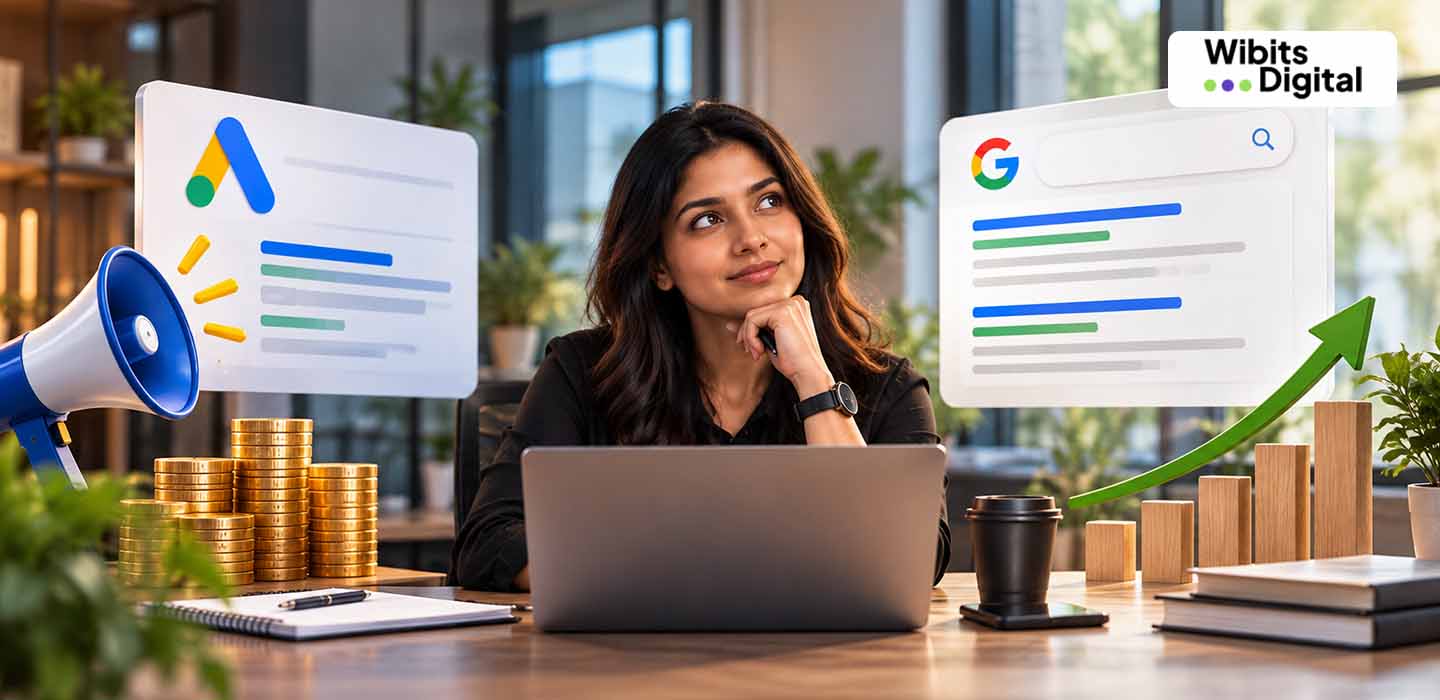
If you’ve ever paid for Google Ads, you probably know how quickly the money can disappear.
One day you’re looking at a reasonable number of clicks. A few weeks later, you’re looking at the bill and wondering how many of those clicks actually turned into customers.
SEO has the opposite problem. You can spend months working on it before you see the kind of traffic you’re hoping for.
So what should a company do with its money?
The straightforward answer is that it varies. Google Ads and natural search serve different needs, and your choice between the two depends on various factors, including your company, the nature of your clients, and the urgency of the results you need.
Google Ads Can Let You Get in Front of Clients Instantly
Say you own a plumbing business and somebody looks up emergency plumbing services in your area late in the evening.
If everything has been properly working in your Google Ads account, you could be seen by these clients straight away.
You will not have to wait for your web page to appear on the search results page. You will not have to wait for months for search engines to become sure of your website. You pay to appear when your potential clients start searching.
That’s the obvious appeal of paid search.
It’s especially useful for a new service, a seasonal offer or a business that needs enquiries now rather than later.
But there is a price attached to that speed. Every click costs money, and the spending doesn’t stop unless you stop the campaign.
SEO Plays a Longer Game
SEO isn’t as satisfying at the beginning.
You publish an effective webpage, optimize it, wait, make revisions further, wait some more until you hopefully see the page in the top search results.
It’s slow because it is.
The advantage of a well-optimized webpage is that it brings organic traffic to your site without payment for every visit.
That being said, SEO is not free. Someone still needs to do research, create content, improve a website, and track ongoing processes.
The difference comes down to the investment nature.
With Google Ads, you buy traffic.
With SEO, you work on the acquisition of traffic.
Don’t Compare Them Only by Cost Per Click
This is where things can get misleading.
Suppose one Google Ads campaign gets clicks for $2 each, while another costs $6 per click.
It would be easy to assume the first campaign is better.
But what if the $2 clicks rarely turn into enquiries, while the $6 clicks regularly bring people who are ready to buy?
The more expensive traffic could actually be the better deal.
That’s why good PPC management isn’t just about trying to get the cheapest possible clicks. The real job is figuring out which searches are bringing the right people and whether those people are doing something useful once they reach the website.
A cheap click that goes nowhere isn’t much of a bargain.
Organic Traffic Can Fool You Too
SEO has its own version of this problem.
A website might suddenly start getting thousands of visitors from Google, which sounds fantastic.
Then you look at the enquiries and realise most of those visitors were looking for information that has nothing to do with what the business sells.
Traffic went up.
Business didn’t.
Thus, this is the main reason I wouldn’t get overly enthusiastic just because of a traffic diagram. The critical questions you should be asking are related to the traffic source, traffic intent, and whether your site actually provides an incentive to contact you.
For example, it is much better to receive a hundred visitors with the clear intention of getting your service than thousands of accidental clicks from people who would probably never buy anything.
What Are Your Customers Actually Searching for?
This is probably the first thing I’d look at before deciding where the budget should go.
If people are already searching for your service and they’re ready to make a decision, Google Ads can be very useful.
Someone searching “emergency dentist near me” has a very different intention from someone searching “how does a root canal work?”
Both searches are relevant to dentistry, but they’re not at the same stage of the buying process.
The same applies to SEO.
Informational searches can bring people into your website early, while service-related searches may bring people who are much closer to contacting you.
Understanding that difference helps you decide where paid and organic search should fit.
Google Ads Makes Sense When You Need Speed
There are situations where waiting for SEO simply isn’t practical.
Perhaps you’ve just launched a new service. Perhaps you’re opening in a new location. Maybe you’ve got a limited-time offer and want people to see it this week.
In those cases, paid search gives you something SEO can’t easily provide: immediate visibility.
You can start with a controlled budget, see what happens and make changes based on actual results.
That last part matters.
Don’t judge a campaign by how many clicks it produces. Look at enquiries, sales, phone calls or whatever action actually matters to your business.
If the campaign is spending money but the people clicking aren’t becoming customers, something needs to change.
SEO Starts Making More Sense When You’re Thinking Long Term
Now imagine you’ve got a business that has been around for several years.
You know the services people search for. You have useful information to share. Your website has a decent foundation, and you’re not relying on next month’s sales to keep the lights on.
That’s a very different situation.
You may be better off putting more effort into organic search because you’re building something that can continue working for you.
A page that reaches the first page for a valuable search can generate traffic for months or even years. It will need maintenance, and rankings can change, but you’re not paying Google each time someone visits.
That can become increasingly attractive as paid advertising gets more expensive.
What About Google Ads Management?
Running ads yourself isn’t impossible.
Google has made the platform easier to use, and a small business can certainly create a campaign without hiring an expert.
The problem usually starts after the campaign has been running for a while.
Which search terms are wasting money? Which ones are bringing customers? Are people clicking the ad and leaving because the landing page doesn’t match what they expected? Are you paying for searches from people outside your service area?
Those questions don’t get answered just by looking at the number of clicks.
Good Google ads management involves looking at the details and making changes based on what the data is telling you.
Sometimes the right decision is to spend more.
Sometimes it’s to stop spending on a particular keyword altogether.
What If You’re a Local Business?
Location can change the whole calculation.
A business serving one town doesn’t need the same strategy as an online company trying to reach customers across the country.
If you’re considering a PPC agency Nagercoil, for example, you should want someone who understands the local market rather than simply handing you a generic campaign template.
The same goes for businesses looking at a PPC agency India for a wider campaign.
Ask where your ads will appear, what searches will be targeted and how the agency will decide whether the campaign is actually working.
Don’t settle for “You’ll get more traffic.”
Traffic isn’t the goal.
Getting the right people to take the right action is.
Can SEO and Google Ads Work Together?
They can, and there are some good reasons to use both.
Paid search can give you quick information about what people respond to. You might discover that one service generates far more enquiries than another, or that a particular type of wording gets much better results.
That information can help shape your SEO work.
At the same time, your organic pages can gradually start taking over some of the searches you’re currently paying for.
You don’t have to treat SEO and PPC like rival teams.
They can do different jobs.
One can help you get attention now while the other works towards reducing your dependence on paid traffic later.
When Should You Spend More On Google Ads?
I’d lean towards Google Ads when you need results quickly and you can clearly measure what a new customer is worth.
It can also make sense when your industry has strong commercial search demand and you have a landing page that does a good job of converting visitors.
The numbers matter here.
If you make $1,000 from an average customer and it costs you $100 in advertising to acquire that customer, the campaign may be perfectly healthy.
If you make $100 per customer and spend $150 to acquire one, you have a problem.
It really is that simple.
When Should You Put More into SEO?
SEO deserves a bigger share when you’re looking beyond the next few weeks.
It is particularly useful if your customers spend time researching before they buy, or if there are lots of questions around your products or services that your website can answer.
It also becomes valuable when you’re tired of paying for every visitor.
A strong organic presence won’t eliminate every advertising cost, but it can give your business another reliable source of enquiries.
And unlike an ad campaign, the work you do on your website doesn’t simply disappear because you paused your monthly budget.
So, Which One Should You Choose?
If you need customers quickly, Google Ads is often the more practical place to start.
If you’re trying to build a steady source of traffic that can support the business for years, SEO deserves serious attention.
For many businesses, though, the sensible answer is both.
Use paid search where you need immediate visibility and where the numbers make sense. Keep improving your organic presence so you’re not dependent on paid clicks forever.
Most importantly, don’t choose based on which channel gives you the nicest-looking report.
A report full of clicks and impressions can look impressive while your sales stay exactly where they were.
Look at the money coming in.
That’s the number that tells you whether your marketing is doing its job.
A Quick Overview of Both
Google Ads: Effective for a situation where visibility is needed immediately and where you can measure the worth of the customers being attracted.
SEO: A more suitable approach for generating organic visibility gradually.
PPC Management: Assists to make sure that the advertising budget is rightly spent.
Using both methods: Often the best solution for getting immediate leads while not neglecting long-term growth.
There isn’t a magic percentage that every business should spend on PPC and SEO. Your industry, margins, competition and customers all change the answer.
Start with those things instead of copying what another business is doing.
That’s usually where the better decision comes from.
Wibits Digital helps businesses with PPC, SEO and digital marketing. If you’re unsure whether Google Ads, organic search or a combination of the two makes more sense for your business, looking at your current traffic, leads and customer acquisition costs is a much better starting point than simply choosing the channel that sounds more popular.