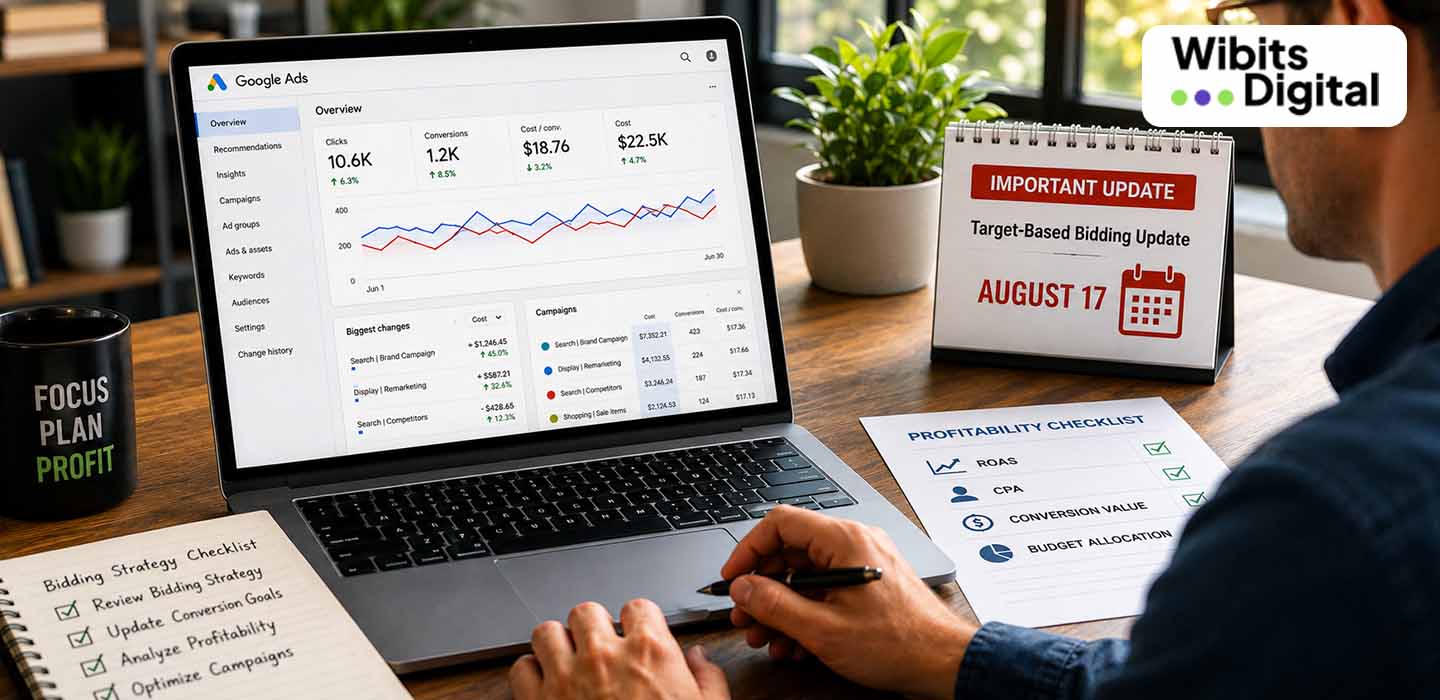
Google Ads management has shifted dramatically over the last few years. Bidding, keyword suggestions, and ad creation rely far more on machine learning today than manual adjustments. While these tools save time, staying profitable requires knowing exactly how the underlying algorithms behave.
Google’s upcoming update to Target CPA and Target ROAS Smart Bidding is a clear example of why that matters.
This isn’t a cosmetic redesign or a new campaign type. It is a fundamental shift in how Smart Bidding handles budget-capped campaigns. If you use Google Ads to generate leads or sales, here is what you need to know before the rollout on August 17, 2026.
Understanding Smart Bidding
To understand this update, it helps to review how Smart Bidding functions in everyday accounts.
When you run an online store or lead generation campaign, Smart Bidding lets you set a high-level performance target instead of setting manual bids for every keyword:
- Target CPA (Cost Per Acquisition): “I want to pay roughly $30 per lead or sale.”
- Target ROAS (Return on Ad Spend): “For every $100 spent, I want $500 in sales revenue.”
During every single search auction, Google evaluates contextual signals like the user’s location, device, time of day, and past search intent to calculate a bid in real time. Rather than applying a single flat bid across the board, auction-time bidding continuously adjusts to find users most likely to convert.
What Is Google Changing?
Until now, budget-constrained campaigns using Target CPA or Target ROAS frequently beat the targets advertisers set.
For instance, if your campaign had a set Target CPA of $30, Google’s algorithm might have consistently delivered leads for $22. Because your daily budget cap forced the system to enter only the cheapest auctions, you received high-efficiency conversions at a discount.
Starting August 17, 2026, Google is closing that gap.
Smart Bidding will no longer use budget limits as a reason to hold back spend. Instead, the algorithm will actively optimize to match the exact target you entered. If your target is set to $30, Google will buy broader inventory to bring your average cost up to that $30 mark.
Why Is Google Making This Change?
Google’s reasoning is straightforward: if an advertiser enters a $30 Target CPA into the system, the algorithm should aim for that $30 target consistently.
When budget caps artificially forced costs down to $22, performance often fluctuated unpredictably whenever an advertiser decided to raise their daily budget. By training the algorithm to hit stated targets regardless of budget constraints, Google aims to make campaign scaling more predictable across the board.
Understanding Budget-Constrained Campaigns
A campaign becomes budget-constrained when its daily budget limit prevents it from entering every available auction during the day.
If your campaign operates on a $50 daily budget, Google cannot show your ads for every relevant query. Previously, Smart Bidding stretched that $50 by prioritizing the lowest-cost conversions first.
Under the new model, Smart Bidding will focus on matching your stated target CPA or ROAS across the auctions it enters, rather than hunting for maximum discount conversions inside the budget cap.
Google Has Introduced the Bid Target Adjustment Tool
To help advertisers adjust before August 17, Google launched the Bid Target Adjustment Tool inside account dashboards on July 6.
This tool flags budget-limited campaigns that currently beat their targets and allows you to update those numbers in a few clicks.
Many businesses set bidding targets months or years ago and never revisited them. Over time, your product margins, conversion tracking setups, or average order values may have shifted. The Bid Target Adjustment Tool gives you a chance to align your account settings with your current profit margins before the new bidding logic goes live.
What Should Businesses Do Before August 17?
You don’t need to rebuild your campaigns or change your entire strategy, but you should run through a quick account review:
- Is your current Target CPA still realistic for your margins?
- Does your Target ROAS reflect your actual product profitability?
- Is conversion tracking firing cleanly without duplicate data?
- Have your pricing or fulfillment costs changed recently?
- Are your daily campaign budgets matched to your current capacity?
Taking twenty minutes to audit these settings now prevents unexpected margin compression after August 17.
A Simple Example
Consider two online retailers running campaigns with a $40 Target CPA:
- Retailer A reviews performance quarterly, keeps conversion tracking clean, and updates bid targets whenever supplier costs change.
- Retailer B set a $40 target two years ago and hasn’t checked the settings since, despite the campaign delivering sales at $25.
When the update lands on August 17, both accounts will optimize toward their set $40 target. Retailer A will continue operating within expected profit margins, while Retailer B will see acquisition costs jump from $25 to $40 overnight simply because their target was outdated.
Also read: Google Ads Budget Optimization: The Hidden Budget Mistakes That Could Be Costing You Thousands
What Does This Mean for Advertisers?
Smart Bidding isn’t becoming better or worse, it is becoming far more literal.
Accounts that actively manage targets, maintain clean conversion data, and review performance regularly will experience a smoother transition. Accounts relying on old placeholder targets will likely see a quiet increase in acquisition costs.
Automated bidding tools handle execution efficiently, but they still rely entirely on the targets you feed them.
How Wibits Digital Helps Businesses Stay Ahead
Platform updates happen constantly, and subtle setting shifts can easily impact performance if left unmonitored.
We handle campaign management proactively so your brand isn’t caught off guard by unexpected algorithm updates. From reviewing target metrics against real contribution margins to updating conversion tracking setups, our team ensures every decision across your ad accounts is driven by real business math.
Want to safeguard your ad spend before August 17?
Reach out to us today for a full Google Ads performance audit.
Official References & Announcement Links
- Google Ads Help Center: Changes to target-based bid strategies
- Google Ads Support FAQs: Frequently asked questions about changes to Target-based bid strategies
- Google Ads Documentation: About Smart Bidding
- Search Engine Journal Analysis: Google Ads Target-Based Bidding Update for E-Commerce